
Composite Decking vs Wood for Commercial Projects: A Buyer’s Comparison
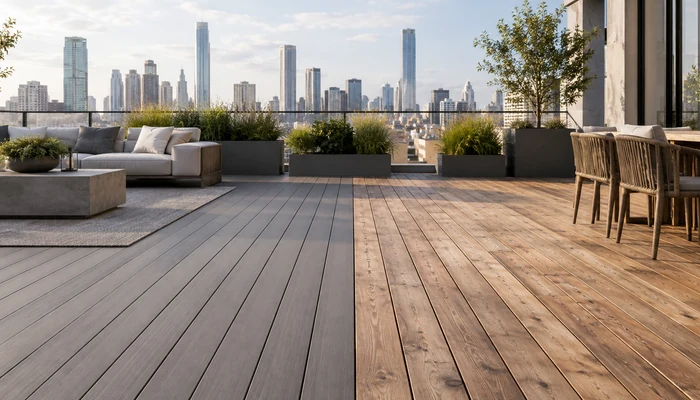
Composite decking and wood decking solve different problems. Composite decking suits projects that need low finishing work and a consistent look. Wood suits projects that need natural species character or a lower upfront board price.
This guide is for distributors, contractors, importers, and commercial buyers. It compares cost, maintenance, performance, standards, and approval documents. It draws on EVODEK export projects in North America, the UK, Europe, and Australia/New Zealand.
Table of Contents
Quick Comparison: Composite Decking vs Wood
| Factor | Composite decking (capped WPC) | Wood decking |
|---|---|---|
| Material | Engineered wood fiber and plastic board, often with a protective polymer cap | Natural timber: treated pine, cedar, hardwood, or thermally modified wood |
| Upfront board cost | Usually higher than treated pine; can be close to premium hardwood | Wide range; treated pine is often the lowest |
| Staining or sealing | Not required | Usually required for appearance and protection |
| Routine care | Cleaning and inspection | Cleaning, inspection, and periodic refinishing |
| Color consistency | Controlled colors, managed by production batch | Natural variation; weathers to grey without finish |
| Surface heat | Can run hotter than wood, especially in dark colors | Usually cooler than composite of a similar color |
| Thermal movement | More lengthwise expansion; needs specified end gaps | Moves more with moisture across the board width |
| Typical warranty | Often 10–25 years commercial (varies by brand) | Varies by species and treatment; often limited |
| Best fit | Long holding periods with limited maintenance staff | Designs led by natural timber or tight initial budgets |
What Should You Check Before Comparing?
Compare the full system, not a single board. “Wood” can mean treated pine or tropical hardwood. “Composite” can mean capped or uncapped boards with very different performance.
Define these project conditions first:
- Use type: hotel terrace, multifamily amenity deck, boardwalk, restaurant patio, or pool surround
- Holding period: how long the owner will operate the deck
- Maintenance owner: who cleans, inspects, and repairs it
- Exposure: full sun, coastal salt, freeze-thaw, shade and damp, or heavy foot traffic
- Regulations: fire zone, slip rules, and public-access requirements
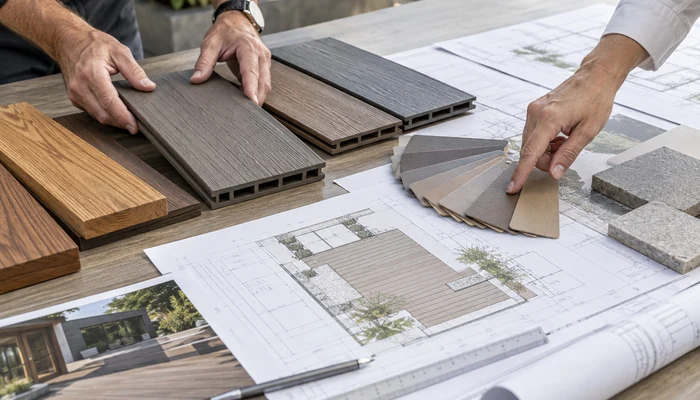
- Documents: shop drawings, submittals, test reports, samples, and warranty terms
How Do Composite and Wood Perform Outdoors?
Moisture and decay
Wood decay is driven mainly by moisture and temperature. The USDA Forest Products Laboratory confirms this in its [Wood Handbook]. Treatment level and species decide how well wood resists it.
Capped composite boards absorb much less water than wood. The cap shields the wood fiber core. Uncapped composite boards are more exposed to staining and mold.
Heat
Composite decking can get hotter than wood in direct sun. Darker colors absorb more heat. For pool decks and barefoot areas, ask for surface temperature data or choose lighter colors.
[Optional: add EVODEK surface temperature test result, test method, and conditions.]
Slip resistance
Both materials can become slippery when wet or dirty. Slip performance depends on the surface texture and on cleaning. Ask for pendulum test results before approving a board for pool or ramp areas.
Thermal movement
Composite boards expand and contract along their length with temperature. This is why end gaps must follow the manufacturer’s chart. Wood moves more with moisture, mostly across its width.
Which Standards Apply in Your Market?
Ask your supplier for test reports against the standards in your region.
| Region | Composite decking standards | What they cover |
|---|---|---|
| USA / Canada | ASTM D7032, ICC-ES AC174 | Performance ratings, span, and guard systems |
| USA | ASTM E84; California WUI (e.g., SFM 12-7A-4) | Flame spread; wildfire-zone decking |
| EU / UK | EN 15534-1, EN 15534-4 | Test methods and decking profile specifications |
| EU / UK | EN 13501-1 | Reaction-to-fire class (flooring classes, e.g., Cfl-s1) |
| UK | BS 7976-2 | Pendulum slip test |
| Australia / NZ | AS 3959 | Construction in bushfire-prone areas (BAL ratings) |
| Australia / NZ | AS 4586 | Slip resistance classification |
Wood decking has its own rules for grading, treatment, and span. In the EU, timber products fall under the EU Deforestation Regulation (EUDR). Importers must complete due diligence, so check the current application date. FSC or PEFC certificates can support sourcing claims.
Deck framing, stairs, and guards are separate structural questions. Involve the responsible engineer and the local authority.

What Does Each Option Really Cost?
Board price is only one line. Compare complete installed scope over the holding period.
| Cost item | Composite decking | Wood decking |
|---|---|---|
| Boards | Higher per board than treated pine | Low (pine) to high (hardwood) |
| Fasteners and trim | System clips, fascia, and matching trim | Screws or clips; site-cut trim |
| Framing | Must meet the board’s span rating | Must meet the species’ span rating |
| Freight and storage | Heavier boards; flat, covered storage | Needs dry storage to control moisture |
| Installation labor | Similar tools; must follow the system guide | Familiar to most crews |
| Finishing | None | Stain or sealer at installation |
| Ongoing care | Cleaning and inspection | Cleaning, inspection, and refinishing |
| Downtime | Short cleaning closures | Longer closures for refinishing and drying |
For a fair comparison, use one drawing set and one scope list. Ask each supplier to quote the same items. Then add 10 or more years of maintenance to each quote.
Avoid fixed “cost per square foot” figures. Labor, freight, and site access change the total a great deal.
How Much Maintenance Does Each Need?
| Task | Composite decking | Wood decking |
|---|---|---|
| Sweeping and debris removal | Regular | Regular |
| Washing | Periodic, with approved cleaner | Periodic |
| Stain or sealer renewal | Not required | Often every 1–3 years, depending on product and exposure |
| Sanding | Not recommended | Before refinishing |
| Board inspection | Check fasteners and surface damage | Check rot, splits, raised grain, and loose fasteners |
| Board replacement | Match by color name and batch | Match by species; color may differ at first |
Low maintenance is not zero maintenance. Composite decks still need cleaning. Grease, leaves, and standing water can stain any deck surface.
For long holding periods, refinishing labor and closure time often decide the comparison. For short holding periods, upfront cost carries more weight.
How Do You Control Appearance and Approval?
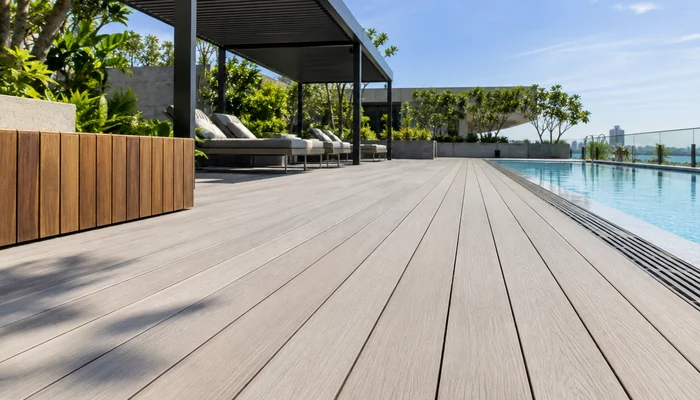
Composite decking offers a fixed color range. Wood offers natural grain and color variation. Both need physical approval steps.
- Request physical samples from the exact product series.
- Review samples in the project’s real light conditions.
- Record the color name, profile, surface texture, and accessory colors in the submittal.
- Ask how the supplier manages batch color differences.
- Build a mockup for visible or complex decks.
A mockup shows board direction, edge details, fastener visibility, and drainage before full installation.
What Should the Installation Documents Include?
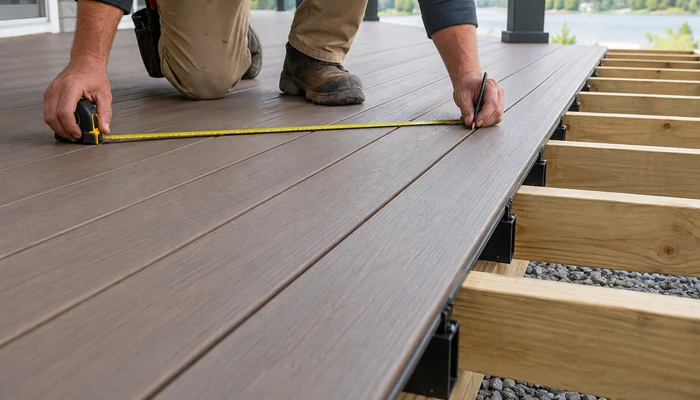
Install composite decking to the named product’s current guide. Do not use generic wood deck rules. The [EVODEK Decking Installation Instructions] set these key points:
- Joist spacing: [X] mm / [X] in on center for residential; [X] mm / [X] in for commercial
- End gaps: [X] mm, based on installation temperature
- Fasteners: [clip model] hidden clips and approved screws
- Ventilation: at least [X] mm clear air space under the boards
- Storage: flat, supported, and covered before installation
Confirm warranty registration, exclusions, and the claim process before the purchase order. For wood, confirm species, treatment level, fastener compatibility, and finish system.
What We See in Export Projects
Across EVODEK export orders, the same mistakes appear again and again:
- Comparing board price only. Buyers skip clips, trim, and fascia, then face cost gaps later.
- Approving color from a screen. On-site color then differs from expectations.
- Ignoring heat on pool decks. Dark boards chosen for looks can be uncomfortable barefoot.
- Using wood joist spacing. Composite spans are often shorter than wood spans.
[Case example: Project type, country, deck area, why composite or wood was chosen, and the result after X years.]
Which Material Fits Your Project?
| If your project… | Consider |
|---|---|
| Has a long holding period and limited maintenance staff | Composite decking |
| Needs consistent color across phases or buildings | Composite decking |
| Must avoid closures for refinishing | Composite decking |
| Requires a specific natural species or timber look | Wood |
| Has a tight upfront budget and an in-house maintenance team | Treated pine or softwood |
| Is a barefoot area in hot sun | Lighter composite colors, or wood; check heat data |
| Is in a bushfire or wildfire zone | Whichever product has the required fire rating |
Frequently Asked Questions
Is composite decking better than wood for commercial projects?
Composite decking is usually better when low finishing work and consistent color matter most. Wood is better when natural species character is the design goal. Compare the exact products and full installed scope.
How long does composite decking last compared to wood?
Capped composite decking often carries 10–25 year commercial warranties, depending on the brand. Wood life depends on species, treatment, and maintenance. Check the warranty terms, not only the headline years.
Does composite decking get hotter than wood?
Yes, composite decking can get hotter than wood in direct sun. Dark colors heat up the most. Ask for surface temperature data for pool and barefoot areas.
Is composite decking slippery when wet?
Composite decking can be slippery when wet or dirty, like wood. Ask for pendulum slip test results, such as BS 7976 or AS 4586, for wet areas.
Is composite decking fire rated?
Some composite boards are fire tested and some are not. Ask for ASTM E84, EN 13501-1, or AS 3959 results that match your market.
Does composite decking need maintenance?
Yes. Composite decking needs regular cleaning and inspection. It does not need staining, sealing, or sanding.
What should a distributor send before requesting a quote?
Send drawings, quantities, board direction, site conditions, color and profile needs, accessories, delivery limits, timeline, and required test standards.
Get an EVODEK Project Comparison
Request samples of the exact series and colors: [link]
Download technical documents, including test reports, the installation guide, and the warranty: [link]
Send your drawings for a scope-based quote: [link]
This guide gives general guidance. It does not replace structural engineering, local code review, or the manufacturer’s current installation instructions.
Related Post


