
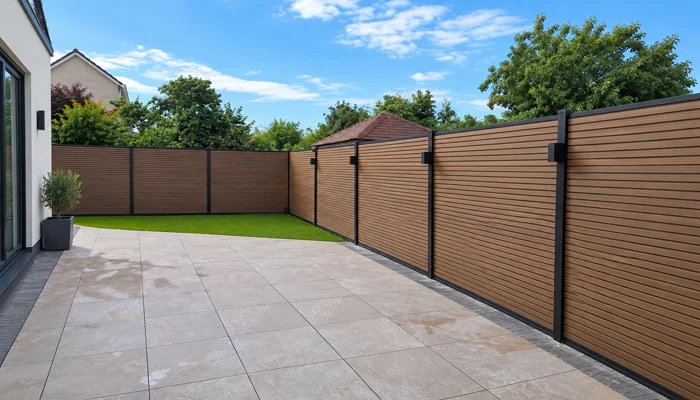
Composite Fence Pickets: Profiles, Sizes, and Installation Guide
Composite fence pickets are individual boards. You fix them one at a time to rails. This gives you control over spacing, height, direction, and gates. This guide covers profiles, sizes, board counts, installation, and ordering.
Table of Contents
What Are Composite Fence Pickets?
Composite fence pickets are separate boards that attach to rails between posts. You can use them for a privacy fence, a spaced screen, or a gate.
They are not universal. Each system has its own board thickness, rail spacing, and fastener positions. Always match the pickets to the post-and-rail system.
If you already have posts in the ground, read how composite fence panels fit concrete posts first.
How Do Composite Fence Pickets Differ From Fence Panels?
Pickets give you more layout control. Panels give you faster, more uniform installation.
| Factor | Individual pickets | Fence panels |
|---|---|---|
| Layout | Custom spacing and patterns | Fixed panel design |
| Gates and odd bays | Cut to fit the opening | Often need a modified bay |
| Installation | Each board is fixed separately | Panels are assembled as units |
| Consistency | Needs careful layout control | Repeated sections look the same |
| Repairs | One board can be replaced | May involve more parts |
Neither option is always cheaper. Cuts, gates, posts, access, and slopes all affect labor and material.
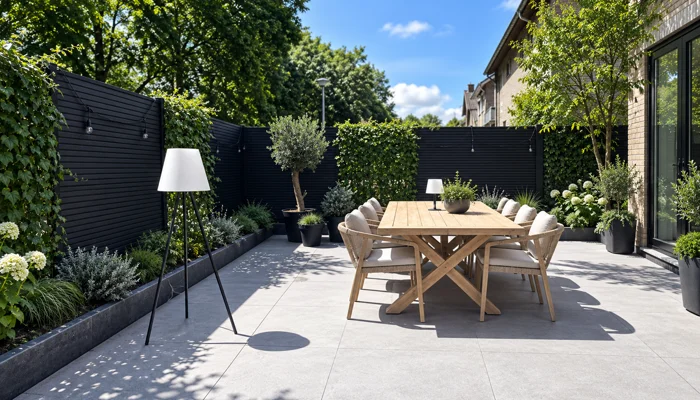
For a privacy-focused layout, the board direction and spacing should support the same visual goals as these composite privacy fence ideas for small backyards.
Which Picket Profile Should You Choose?
Choose the profile that fits your fence direction, privacy needs, and rail system. Start with the board shapes your system approves. Do not choose by looks alone.
Vertical Pickets
Vertical composite pickets give a classic fence look. They suit privacy fences, spaced screens, and gate infill. Leave the gap the manufacturer specifies. Leave bottom clearance too, so water can drain.
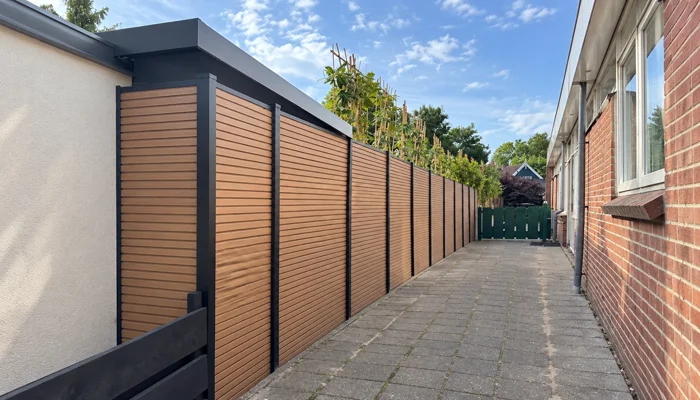
Horizontal Pickets
Horizontal composite pickets give a modern, linear look. Each board spans between posts or rails, so support matters more. A board made for vertical use may not be rated for horizontal spans. Check this before you buy.
| Feature | Vertical pickets | Horizontal pickets |
|---|---|---|
| Look | Traditional | Contemporary |
| Support | Rails carry the load | Boards span between posts |
| Main risk | Uneven gaps over the run | Sagging if rails are too far apart |
| Best for | Privacy fences and gates | Screens and modern designs |
Solid vs. Hollow Boards
Solid and hollow boards differ in weight and cutting. They also differ in fastener needs and allowed span. Choose the board as part of the full system. That includes posts, rails, caps, trim, and hardware.
The outer layer matters too. Read capped vs. uncapped composite fencing to see how a cap affects surface protection. Then confirm the actual product specification.
What Sizes Matter When Specifying Composite Fence Pickets?
You need actual dimensions, not nominal ones. EVODEK’s public pages reviewed for this article do not publish one universal individual-picket size, rail spacing, or ground-clearance value. Those details vary by fence system and must come from the current product sheet and installation guidance for the selected profile.
| Dimension | Published EVODEK information | What to confirm before ordering |
|---|---|---|
| Board face width | No universal individual-picket value published | Actual board face width for the selected profile |
| Board thickness | No universal individual-picket value published | Actual thickness and compatible fastener locations |
| Board length | No universal individual-picket value published | Available length, cut allowance, and gate use |
| Gap between boards | EVODEK’s concrete-post installation guidance specifies 2.5–5 mm between slats | Whether that slat gap applies to the selected picket system |
| Post spacing | No universal value published | Maximum permitted span and post center spacing |
| Rails per bay | EVODEK’s concrete-post method uses post grooves and stacked slats | The rail or channel layout required for the selected system |
| Ground clearance | No universal value published | Product clearance, drainage, and local-code requirements |
Also ask about edge distance, fastener spots, maximum gate width, and trim sizes. Do not substitute a general fence range for an EVODEK product specification.
How Do You Estimate the Number of Pickets?
Divide the fence width by the board width plus the gap.
Pickets = fence width ÷ (board face width + gap)Example: A fence is 20 ft long. That is 240 in.
- Board face width: 5.5 in
- Gap: 0.25 in
- 240 ÷ 5.75 = 41.7, so 42 boards
- Add 10% for cuts and damage: 46 boards
Small changes add up. On a 50 ft fence (600 in), a 5.5 in board needs 105 pickets. A 5.75 in board needs 100. That is five fewer boards.
Your list also needs posts, rails, brackets, caps, fasteners, trim, and footings. Read common fencing mistakes that cost time and money before you finalize it.
How Should Composite Fence Pickets Be Installed?
Install pickets on a frame that is level, plumb, and fully supported. Follow your system’s instructions.
- Set the posts and footings. Check the line and spacing.
- Fix the rails or channels. Check level and height.
- Mark the picket layout with a story pole or guide.
- Set the first picket. Check it plumb.
- Fix each picket with approved fasteners. Use spacers for the gap.
- Check the first few boards from several angles.
- Add caps and trim.
Build the Frame First
Posts and rails carry the load. Do not use pickets to fix a crooked frame. Fix the frame instead.
Use Approved Fasteners
Screw type, pilot holes, and edge distance vary by product. Use the hardware your system lists. Over-tightening can block movement or mark the board.
Keep Spacing Even
Use spacers or a marked guide. Small errors show up clearly on a long fence line.
Build Gates as Separate Frames
A gate is heavy and moves often. Rails alone cannot carry it. Build a proper gate frame with the right hinges and latch.
EVODEK’s published Fence Gate model is listed at 1100 mm × 1800 mm. Treat that as a gate-model dimension only, not as a picket dimension or proof that it fits every fence layout. Confirm the matching frame, hinges, latch, and fence system before ordering.
| Common gate problem | Likely cause | Fix |
|---|---|---|
| Gate sags | Frame too weak | Add a diagonal brace |
| Gate rubs the ground | Not enough clearance | Raise the hinges |
| Latch misses | Post has moved | Reset the post |
How Do You Install Pickets on a Slope?
There are two common methods. Pick one for the whole run.
- Stepped: Each bay stays level. The fence drops in steps.
- Racked: The rails follow the slope. The fence stays parallel to the ground.
Check that your rail system allows racking. Not every system does. Keep the same bottom clearance along the whole run.
What Height Should You Choose?
Height depends on privacy needs and local rules.
| Use | Common height | Note |
|---|---|---|
| Garden or front yard | 3 to 4 ft | Often limited by local code |
| Backyard privacy | 6 ft | Most common choice |
| Pool barrier | 48 in minimum | Local codes may require 60 in |
The U.S. Consumer Product Safety Commission advises a pool barrier at least 48 inches high. It also sets limits on bottom clearance and openings. Read the full CPSC Safety Barrier Guidelines for Residential Pools. Then check your local code.
Composite vs. Other Fence Materials
| Factor | Composite | Wood | Vinyl | Aluminum |
|---|---|---|---|---|
| Painting or staining | Not needed | Needed | Not needed | Not needed |
| Privacy | High | High | High | Low |
| Looks | Wood-like | Natural wood | Smooth, plain | Metal |
| Upfront cost | Higher | Lower | Medium | Medium to high |
| Upkeep | Cleaning | Regular sealing | Cleaning | Low |
Compare total cost over the life of the fence, not just the first price.
For a material-by-material decision, whether composite fences are better than wood explains the maintenance and ownership factors that can change a comparison.
Do Composite Fence Pickets Need Expansion Gaps?
Yes. Composite pickets move with temperature. They need the gaps the manufacturer specifies.
Gaps also help water drain. The right size depends on the board, its length, the climate, and the temperature at install. Do not copy a gap from another brand. Industry standards such as ASTM D7032 test composite boards for temperature, UV, and freeze-thaw effects. Ask your supplier which test results apply. Then check the current EVODEK installation guide.
What Affects the Cost?
A board price alone does not give a fence price. These factors change the total.
Project owners who prioritize lower upkeep can also compare the factors in EVODEK’s guide to the lowest-maintenance fence material.
| Cost factor | Why it matters |
|---|---|
| Fence height | Taller fences need more boards and stronger posts |
| Number of gates | Gates need extra framing and hardware |
| Slope | Slopes need more cuts and more waste |
| Footings | Soil and frost depth change the work |
| Site access | Hard access raises labor time |
| Delivery | Long boards cost more to ship |
| Permits | Fees vary by location |
How Do You Maintain Composite Fence Pickets?
Clean the fence and inspect it. Do this at least once a year.
- Remove dirt and leaves.
- Wash with mild soap and water. Follow the product’s care guide.
- Check fasteners and gate hardware.
- Check that water drains from the bottom of the boards.
Read the guides on whether composite fences fade and whether composite fences warp before you decide.
What Should You Confirm Before Ordering?
Confirm the whole system. A board price does not prove the fence can be built.
| Check | Why it matters |
|---|---|
| Profile and direction | Confirms the board suits your layout |
| Post and rail match | Avoids mismatched parts |
| Real dimensions and gaps | Gives an accurate board count |
| Fasteners, trim, and caps | Avoids missing parts |
| Gate and corner details | Plans special framing early |
| Permit rules | Covers height and boundary limits |
| Delivery and access | Avoids damage and delay |
Rules vary by location. Read whether you need a permit to put up a fence early. This matters most for tall fences, corner lots, and pool barriers.
What Project Details Should You Send for a Quote?
Send the fence length, target height, layout direction, gate locations, slope information, post condition, delivery location, and preferred color or surface finish. Include photos and a simple site sketch when available. These details allow EVODEK to confirm the appropriate fence system and provide a project-specific material list without relying on generic picket dimensions.
Conclusion
Composite fence pickets give you control over layout, height, and gates. Remember three things:
- Choose pickets that match your post-and-rail system.
- Confirm real board sizes and gaps before you order.
- List every part, not just the boards.
Want to see the boards in person? Request EVODEK composite fencing samples. Ready to price your fence? Request a project quote with your fence length, height, and layout.
FAQ
Are composite fence pickets better than fence panels?
Pickets are better for custom spacing, odd bay sizes, and tailored gates. Panels are better when you want a fast, repeated layout.
Can composite fence pickets be installed horizontally?
Yes, if the board and rail system are approved for horizontal use. Confirm rail spacing and fastener rules first.
How far apart should composite fence pickets be spaced?
A typical gap is 1/8 to 1/4 inch. Always follow your product’s instructions. The right gap depends on board size, temperature, and drainage. For pool fences, local code also limits the gap.
Can I replace one damaged picket?
Often yes. You need access to the fasteners and a matching board. Check how the board is fixed and whether trim must come off first.
Do composite fence pickets need painting or sealing?
No. Do not paint or seal them unless the manufacturer allows it. Clean them with mild soap and water instead.
How many pickets do I need for a 20 ft fence?
With 5.5 in boards and a 1/4 in gap, you need about 42 boards. Add 10% for waste. That gives about 46 boards.
Related Post


